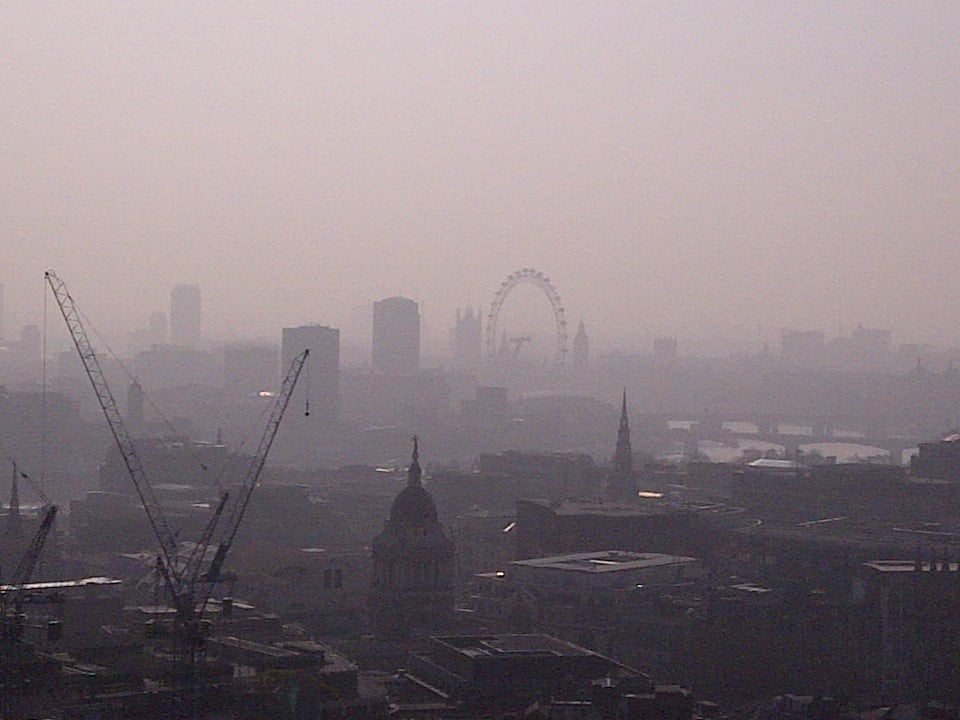
The purpose of the cross-party Campaign for Clean Air in London is to achieve urgently and sustainably at least World Health Organisation (WHO) recommended standards of air quality throughout London.
Air pollution near many of London's busiest roads averages well over twice the WHO's maximum recommended levels. When the political will existed in the past, air pollution issues were tackled quickly, for example the ozone layer, leaded petrol, acid rain and pea-souper smogs. All that is needed now is for the Prime Minister to insist that the United Kingdom will comply fully with air quality laws. If you are worried about air pollution, please email the Ministers responsible for air quality at hilary.benn@defra.gsi.gov.uk and ruth.kelly@dft.gsi.gov.uk telling them about your concerns and ask them to press the Prime Minister for such a commitment. It really is that simple.
In practice, most of these standards will need to be met by January 2012 if the United Kingdom is to comply with air quality laws.
more »
|
|
||||
|
Saturday, September 27
by
Simon Birkett
on Sat 27 Sep 2008 19:18 BST
CAMPAIGN RESPONSE: 27 September 2008
Boris Johnson Mayor of London and Chair of Transport for London Transport for London Western Extension Consultation 12th Floor Windsor House 42-50 Victoria Street London SW1H 0TL Congestion Charging Western Extension Consultation Chiswick Gate 598 – 608 Chiswick High Road London W4 5RT By email: westernextension@tfl.gov.uk and mayor@london.gov.uk Dear Mayor Johnson, Consultation on the future of the Congestion Charge Western Extension (CCWE) Keep the Congestion Charge Western Extension or an even tougher, additional, inner Low Emission Zone will be needed by early 2010 This response to Transport for London’s (TfL’s) public consultation on the future of the Congestion Charge Western Extension (CCWE), which is due to close on 5 October 2008, is sent on behalf of the Campaign for Clean Air in London (CCAL). See: http://www.tfl.gov.uk/tfl/roadusers/congestioncharging/westernextension/default.aspx In your letter to CCAL, dated 31 July 2008, you requested that CCAL submit a formal response to this consultation in September. Summary Government maps, recently published by CCAL, highlight yet again, that road transport is the biggest single cause of all breaches of air quality laws across London. The solutions needed involve two overlapping ‘circles’ of measures – one for congestion (since vehicles are about half as polluting once they reach speeds of 30 kilometres per hour) and the other for emissions (such as low emission zones) – that target the most polluting vehicles in the most polluted areas. CCAL urges the Mayor of London (the Mayor) to keep the CCWE primarily on the grounds that traffic levels would rise significantly without it, leading to increased pollutants from vehicles. In CCAL’s view, it would be foolish of the Mayor to remove the CCWE when he would then need to toughen further additional measures, such as one or more additional inner low emission zones, that are already long overdue to reduce sharply hazardous vehicle emissions to comply with air quality laws in the same area of London. CCAL urges the Mayor to pursue vigorously stronger measures to reduce congestion across London. Instead of weakening (or removing the CCWE), the Mayor should build on the current ‘blunt instrument’ by offering dynamic (or ‘intelligent’) road pricing, such as ‘tag and beacon’ or better, in parallel with the current CCWE and Congestion Charge Central (CCC). This would give people the choice of paying a fixed congestion charge or opting to pay a flexible charge i.e. such that they might pay nothing to drive short distances outside the hours of congestion. In due course, once dynamic road pricing is shown to work well, it should take over fully from the current ‘blunt’ scheme and be extended to operate, where necessary, across London. CCAL is concerned that a relatively small number of vehicle owners, who are primarily responsible for congestion, are - at little or no cost to themselves - having a disproportionate, negative impact on the health of hundreds of thousands of Londoners. Those causing congestion should pay the full environmental cost of their actions as part of a much wider ‘polluter pays’ strategy in London. CCAL supports measures to reduce congestion, in their own right, as a means of increasing road capacity and improving quality of life for the vast majority of Londoners. Last but most importantly, CCAL emphasises the need for the Mayor to work closely with the government to implement measures urgently to ensure that air quality laws are fully complied with throughout London not just in the CCWE area. Congestion and emissions measures are both needed to improve air quality in London The government has admitted that road transport is the cause of all the breaches of air quality laws in the United Kingdom (UK) with diesel emissions being by far the biggest single component. The solutions needed involve two overlapping ‘circles’ of measures – one for congestion and the other for emissions – that target the most polluting vehicles in the most polluted areas with technology-based solutions and create a ‘tipping point’ of behavioural change backed by awareness, persuasion, incentives and regulation (when necessary). Behavioural change offers the most cost effective solutions. In CCAL’s view, the package of measures needed to reduce emissions to comply with air quality laws (which are based on World Health Organisation (WHO) recommendations) must include one or more additional inner Low Emission Zones (LEZs) operating in London by early 2010 (since an LEZ directly targets air pollution and makes the ‘polluter pay’). In general, it or they should target all the most polluting vehicles in the most polluted areas in order to minimise and share the necessary costs. Dozens of other cities around Europe are introducing similar schemes in order to comply with the same laws. See: http://www.lowemissionzones.eu/ In CCAL’s view, measures to reduce congestion are needed also to tackle the most polluted areas of London since hazardous emissions fall sharply as vehicles move faster. Department for Transport (DfT) data shows that most vehicles emit about half the carbon dioxide (CO2) and hazardous emissions once they reach speeds of 30 kilometres per hour. Vehicles causing congestion are therefore some of the biggest polluters. CCAL supports measures to reduce congestion, in their own right, as a means of increasing road capacity and improving quality of life for the vast majority of Londoners. Air quality laws It is the responsibility of the Mayor and the government to be aware of, and comply fully with, all applicable laws. The government has specific duties under air quality laws on behalf of the UK as a Member State. CCAL wishes to draw your attention to the following: i. The Mayor has a duty to ‘work towards’ the Limit Values: The Mayor of London has a statutory duty to ‘work towards’ the Limit Values for particulate matter (PM10) and nitrogen dioxide (NO2). The Supplementary Information document for the CCWE consultation states on page 27 that the impacts on the CCWE area of returning traffic in 2010 ‘are estimated [at] around 5 per cent more NOx [oxides of nitrogen], 7 percent more PM10 and 8 percent more CO2 [carbon dioxide] ’. In CCAL’s view, the Mayor would breach this statutory duty if he removed the CCWE without fully offsetting measures being in full operation. ii. The UK has a duty to achieve the Limit Values by deadlines: The UK has breached air quality laws in London for PM10 in each of 2005, 2006 and 2007. The government plans to apply for a time extension until 2011 to meet these obligations, as it is allowed to do under the EU directive on ambient air quality and cleaner air for Europe (the AQ Directive), which entered into force on 11 June 2008. To obtain such a time extension and avoid imminent legal action, the UK would need, amongst other things, to produce credible plans showing how it would eliminate all breaches of Limit Values for PM10 by 2011. If a time extension for PM10 is allowed by the European Commission (EC), Article 22 of the AQ Directive states that the UK must ensure that the Limit Value plus Margin of Tolerance is not exceeded in any circumstances i.e. average annual PM10 levels must never exceed 48 micrograms per cubic metre (ug/m3). Daily average exceedances are also limited. The government maps obtained by CCAL show that Brompton Road and Knightsbridge in the CCWE area are currently still expected to be in breach of air quality laws for PM10 in 2011. In CCAL’s view, measures to reduce congestion (such as the CCWE) and emissions are both needed to eliminate these breaches of air quality laws. The EC, seeking to enforce WHO based air quality laws, has asked Member States (including the UK) to provide information by 30 September 2008 on the steps they are taking to achieve compliance with air quality laws for PM10. The EC has stated further that failure either to achieve compliance with the standard or to submit notifications by 31 October 2008 for a time extension will lead to legal action against the Member State concerned. See: http://europa.eu/rapid/pressReleasesAction.do?reference=IP/08/1112&format=HTML&aged=0&language=EN&guiLanguage=en In CCAL’s view, the Mayor would show disregard for air quality laws if the removal of the CCWE is pursued when neither he nor the government have yet shown how air quality laws for PM10 (or NO2) will be complied with in the CCWE area and throughout London. CCAL wrote to the EC on 5 May 2008 on this subject copying you. iii. The UK has a duty to maintain air quality once the Limit Values are met: The UK has an obligation under Council Directive 1999/30/EC/Article 1 to ‘maintain ambient air quality where it is good and improve it in other cases with respect to sulphur dioxide, nitrogen dioxide and oxides of nitrogen, particular matter and lead’. This obligation has been transposed into UK law in the Air Quality Limit Values Regulations 2003 in Regulation 15, paragraph 2 (see page 8). By referring in the latter to ‘zones’ the government may not have been transposed correctly – with that mistake alone, perhaps exposing the UK to infringement action by the EC. This directive is repealed by the new AQ Directive with effect from 11 June 2010. The excellent London Air Quality Network website shows that average annual PM10 in Cromwell Road fell from just on the Limit Value in 2006 (i.e. 40 ug/m3) to 35 ug/m3 in 2007 (and 34 ug/m3 so far in 2008). 2007 included nearly 11 months of the CCWE in operation. The number of days exceeding 50 ug/m3 fell from 60 to 26 in the same period (with the Limit Value for exceedances being 50) i.e. that section of Cromwell Road moved from non-compliance to compliance for PM10 in 2007. In CCAL’s view, the government has a clear statutory duty (and obligation as a Member State) inter alia to ensure that PM10 air pollution does not rise again above the Limit Values in the CCWE where it has fallen below these levels – as it surely would if road pricing was removed from that area (unless simultaneously other measures were put in place to mitigate fully its removal). CCAL is therefore forwarding this letter to the government and urging it to comply fully with these obligations, if necessary forcing the Mayor to keep the CCWE. iv. The UK has a duty to ensure that the Limit Values plus a Margin of Tolerance are not exceeded if the time extension provisions are used: The UK is required to comply with Limit Values for NO2 by January 2010. Under the new AQ Directive, the UK may apply for a time extension to comply with these Limit Values until January 2015. Similar provisions apply for NO2 as apply for PM10, not least under Article 22, such that if the UK is granted a time extension it must ensure that the Limit Value plus a Margin of Tolerance is not exceeded in any circumstances i.e. average annual NO2 levels must never exceed 60 ug/m3. Hourly average exceedances are also limited. Average annual NO2 levels far exceed 60 ug/m3 in parts of the CCWE e.g. Brompton Road, Knightsbridge and Kings Road. Maps in the City of Westminster’s current consultation on its air quality strategy highlight the seriousness of this problem across central London into 2010 and beyond. If no time extensions are granted, the Limit Values must be complied with by the times already specified in legislation. In CCAL’s view, congestion and emission measures are both needed if the UK is to reduce air pollution near London’s busiest roads by more than one-third by January 2010 as required by air quality laws. Please consider this letter as a formal reminder to you, as Mayor of London, of these issues. Response to Consultation Questions These responses must be considered in conjunction with the rest of this submission. CCAL supports keeping the CCWE so that it, and the CCC area, can play a valuable part in improving - and not making worse - air quality in London. If you as Mayor decide to remove or weaken the CCWE, it is plain – all other things being equal - that you will need to tighten commensurately and concurrently the additional inner LEZ(s) that must be operating in London by early 2010. To over-simplify it: ‘let 33,000 vehicle owners choose not to pay £8 to enter the CCWE; or ban an extra 33,000 vehicles each day from the additional inner LEZ(s)’. CCAL urges the Mayor to strengthen the CCWE (and the CCC); CCAL set out measures to improve the CCWE and air quality in general in London in its letter to you dated 13 July 2008 (which is attached and included as part of this submission): http://www.cleanairinlondon.org/blog/Campaignletters/_archives/2008/7/13/3790981.html In respect of the current, narrow, consultation questions, CCAL notes that those opting for any of the Option 3 alternatives are also implicitly supporting Option 1. CCAL considers that the Mayor should have included a fourth option with measures that would ‘strengthen’ the CCWE e.g. operating it seven days per week and the CCC and CCWE as two co-ordinated, independent schemes. As currently constructed, the consultation is biased towards removal of the CCWE. Option 1 Yes. CCAL would like it to kept and strengthened CCAL urges the Mayor to keep the CCWE and embrace road pricing, where necessary, across London. Congestion charging should be a meaningful part of the package of measures needed to comply fully with air quality laws. Option 2 No, strongly oppose CCAL urges the Mayor not to remove the CCWE since to do so will make it necessary for him, all other things being equal, to introduce concurrently stronger measures to improve air quality than will otherwise be necessary. Option 3a Neither CCAL does not object to small administrative changes to the CCWE or the CCC, such as on payment terms, provided that the impact of these on emissions is fully and concurrently offset by commensurately stronger terms as part of one or more additional inner LEZs. Option 3b Strongly oppose CCAL objects to the Mayor’s proposal to introduce a charge-free period in the CCWE with the effect that ‘traffic and congestion levels could increase significantly during the free period’. Option 3c Neither CCAL does not object to small administrative changes to the CCWE or the CC, such as on payment terms, provided that the impact of these on emissions is fully and concurrently offset by commensurately stronger terms as part of one or more additional inner LEZs. CCAL would be pleased to meet you or your advisers to discuss these proposals as you proposed in your letter dated 31 July 2008. Please confirm receipt of this letter. With best wishes. Yours sincerely Simon Birkett Principal Contact Campaign for Clean Air in London more » Sunday, August 31
by
Simon Birkett
on Sun 31 Aug 2008 16:35 BST
CAMPAIGN UPDATE: 31 August 2008
Government maps show that 40 kilometres of roads across 13 London boroughs are still due to breach air quality laws for particulate matter (PM10) in 2011 and beyond Government must submit to the European Commission by 31 October 2008 plans to eliminate all breaches of air quality laws for PM10 by 2011 (or earlier) or the European Commission says it will launch legal action against the UK to enforce air quality laws Jonathan Shaw MP, Minister for Air Quality, wrote to Mayor Johnson offering help as the government looks set to struggle to justify a time extension for PM10 and must take urgent action also to comply with air quality laws for nitrogen dioxide by January 2010 Mayor Boris Johnson replies personally to ‘Clean Air in London’ saying he is “passionately committed to improving air quality in London” and “committed to taking bold action to try to meet the requirements” of air quality laws Summary Commenting on the latest developments on air quality in London, Simon Birkett, Principal Contact for the Campaign for Clean Air in London (CCAL), said: “Air quality laws for particulate matter (PM10) were breached in London in each of 2005, 2006 and 2007. Maps obtained by the Campaign for Clean Air in London reveal that the government still expects these laws to be breached in London in 2011 and beyond. In addition, air quality laws for nitrogen dioxide (NO2) require at least a one-third reduction in that form of air pollution near London’s busiest roads by January 2010. “The UK will be subject to legal action for breaching air quality laws for PM10 unless it notifies the European Commission (the Commission) by 31 October 2008 of a request for a time extension and provides plans to eliminate all UK breaches of air quality laws for PM10 by 2011 (or earlier). In CCAL’s view, the UK will struggle to justify such a time extension. This may explain why the government currently plans to miss this new deadline by eight months or more – amazingly, given that the over-riding obligations have been in legislation since 1999. “The government needs to agree radical new plans with Mayor Johnson within weeks that will reduce sharply air pollution in London if the UK is to stand any chance of avoiding legal action for breaching air quality laws based on World Health Organisation recommendations. Realistically, a two-month public consultation needs to be launched by Mayor Johnson by 31 October 2008 with detailed plans to meet fully obligations for PM10 and NO2, if businesses and the general public are to be given sufficient notice of the major changes required of them by January 2010 (e.g. in road transport). “The air quality plans will almost certainly need to include one or more additional, inner, Low Emission Zones (LEZs) in London with standards for the abatement of hazardous emissions from the most polluting vehicles of all sorts. These inner LEZs will need to set tighter standards, for both particulate matter and emissions of oxides of nitrogen than the existing London-wide LEZ. Dozens of cities across Europe are already planning such LEZs to comply with the same air quality laws. “After nearly 10 years, the government has finally run out of excuses. Ironically, with just 61 days to go before the Commission launches legal action against the UK for breaching air quality laws for PM10, the Labour government is dependent now on a Conservative Mayor of London to save the UK from the harsh reality of unlimited fines. “If the government misses the Commission’s deadline of 31 October 2008 for submitting a time extension notification for PM10 (or complies in part only with it), CCAL will be urging the Commission to launch immediately thereafter legal action against the UK for breaching air quality laws as it has promised to do. With no safe level of exposure to particulate matter, these minimum legal obligations must be complied with in full. If the government meets this deadline, CCAL will be urging the Commission to review thoroughly the UK’s plans for compliance.” The maps and letters referred to in this Campaign Update are attached to it. Government maps show that 40 kilometres of roads across 13 London boroughs are still due to breach air quality laws for particulate matter (PM10) in 2011 and beyond The UK was required by 1999 legislation to reduce the public’s exposure to particulate matter (PM10) air pollution. Air quality laws required two ‘Limit Values’ to be met by 1 January 2005: an annual average exposure not to exceed 40 micrograms per cubic metre (ug/m3) and a daily mean exposure not to exceed 50 ug/m3 on more than 35 days per annum. The UK breached both Limit Values in each of 2005, 2006 and 2007 and has no plans yet to comply with the daily mean Limit Value across London. The new European Union (EU) Directive on ambient air quality and cleaner air for Europe (the new AQ Directive), which entered into force on 11 June 2008, gives the UK and other Member States the opportunity, subject to strict conditions, to seek a time extension to comply with air quality laws for PM10 until 2011 with dispensation from breaching these air quality laws in 2005, 2006 and 2007. One of these strict conditions is that the government must show how it will eliminate all breaches in the UK of air quality laws for PM10 by 2011. CCAL therefore asked the Department of Environment, Food and Rural Affairs (Defra) to release detailed maps showing the remaining locations in the UK where air quality laws for particulate matter (PM10) will still be breached in 2011 and beyond i.e. the places where the government is unable currently even to meet a key condition for a time extension. Defra provided those maps which are attached to this Campaign Update. The government maps show that the only remaining breaches in the UK of air quality laws for PM10 by 2011 are forecast to be the daily mean Limit Value along about 40 kilometres of roads across some 13 boroughs in London. The government expects to have eliminated from the UK all other breaches of air quality laws for PM10 before 2011. The government maps show in red the sections of the roads in London that are expected to exceed an annual average concentration for PM10 of 31.5 ug/m3 in 2011. This is the government’s best estimate of the places where PM10 exposures will exceed 50 ug/m3 on more than 35 days in 2011. The government adopts this widely accepted mechanism since it would be difficult to forecast now which days in 2011 might exceed a mean of 50 ug/m3. Maps showing where the daily mean Limit Value for PM10 are due to be breached in 2011 and beyond in London are attached and can be seen at: Summary map of London (file size of 171 KB): http://www.cleanairinlondon.org/blog/IntroductiontoAirQualityinLondon/_archives/2008/8/31/3862405.html Summary maps of London plus maps of 13 London boroughs (note large file size of 2.1 MB): http://www.cleanairinlondon.org/blog/IntroductiontoAirQualityinLondon/_archives/2008/8/31/3862404.html The government has no plans yet to comply with air quality laws for PM10 near these roads. Government must submit to the European Commission by 31 October 2008 plans to eliminate all breaches of air quality laws for PM10 by 2011 (or earlier) As mentioned earlier, the new AQ Directive gives the UK the opportunity, subject to strict conditions, to seek a time extension to comply with air quality laws for PM10 until 2011 (or earlier) with dispensation from breaching these air quality laws in 2005, 2006 and 2007. One of these strict conditions is that the government must show how it will eliminate across the UK all breaches of PM10 air quality laws by 2011 (or earlier). CCAL’s understanding of the legal situation is as follows: 1. the UK is currently in breach of air quality laws for particulate matter (PM10) in each of 2005, 2006 and 2007. It will remain in breach of these laws for each of those years unless it obtains a time extension from the European Commission (the Commission); 2. the new AQ Directive allows the UK and other Member States, technically, to submit any time extension notification request to the Commission at any time. However, it would be unreasonable to allow the UK more than four months to do so for PM10 since: these laws have been required to be met by 1999 legislation since January 2005; the UK government has known details of the time extension mechanism since they were agreed in a compromise between the European Parliament, the Council of Ministers and the Commission and approved by the European Parliament on 11 December 2007; and the government consulted as recently as Autumn 2007 on its plans then to comply with those same obligations (so they need only to be updated). The Commission’s guidance on time extensions can be found via the following link (see particularly the Staff Working Paper and other attachments); http://ec.europa.eu/environment/air/quality/legislation/time_extensions.htm 3. the Commission announced on 8 July 2008 (see link below) that legal action would follow, presumably on existing breaches of air quality laws for PM10, if the UK and other Member States do not submit their formal time extension notification requests for PM10 by 31 October 2008 i.e. they were given nearly four months final warning; http://europa.eu/rapid/pressReleasesAction.do?reference=IP/08/1112&format=HTML&aged=0&language=EN&guiLanguage=en Member States have been asked also to submit to the Commission by 30 September 2008 information on the steps they are taking to achieve compliance with air quality laws for PM10; 4. to obtain a time extension to meet the PM10 Limit Values until 2011 (or earlier) the onus is on the UK to satisfy fully the Commission that: i. conformity with the Limit Values for PM10 could not be achieved by 1 January 2005 because of site specific-characteristics, adverse climatic conditions or transboundary contributions; and ii. all applicable measures were taken at national, regional and local level to meet the deadlines; and iii. it has a convincing air quality plan to comply fully across the UK with the daily mean and annual average Limit Values for PM10 by 2011 (or earlier); 5. where the Commission has raised no objections within nine months of receipt of that notification, the relevant conditions for a time extension shall be deemed to be satisfied. If objections are raised, the Commission may require the Member State to adjust or provide new air quality plans; and 6. if the UK misses the deadline of 31 October 2008 and/or does not submit an air quality plan that satisfies the Commission that it will eliminate the breaches of Limit Values for PM10 in London, it will be subject to legal action for breaching these Limit Values in 2005, 2006 and/or 2007. This will involve the Commission asking the European Court of Justice (ECJ) to require the UK to remedy these breaches immediately (i.e. no delay allowed until 2011). If the UK fails to comply with ECJ’s requirements, the Commission can ask the ECJ to impose unlimited lump sum and daily fines against the UK. The government has admitted that it plans currently to launch yet another public consultation in early 2009 on its plans to comply with Limit Values for PM10 with a view to submitting a time extension notification request to the Commission by ‘summer 2009’. This timetable clearly sets the government on a collision course with the Commission and the ECJ. Worse still, the government does not plan to commence a consultation on measures to comply with air quality laws for nitrogen dioxide until 2010. Its current consultation on NO2 is intended to meet only the requirements of historic air quality laws not those of the new AQ Directive. Similarly, Mayor Johnson’s letter to CCAL states he plans to launch a public consultation on his Air Quality Strategy by June 2009. Simon Birkett, Principal Contact for CCAL, said: “In CCAL’s considered view, the government will struggle to obtain a time extension to comply with air quality laws for PM10. How can the UK argue that: it has ‘street canyons’ everywhere; climate change has been with us for years already; or that transboundary particulate matter has been arriving in the UK against the prevailing winds? What measures did the UK take before 2005 at a national, regional and local level that made a real difference to air quality? Where are the plans to comply with air quality laws across London by 2011? “In an approach that will compound the government’s difficulties, its plan to miss the Commission’s deadline of 31 October is cynical and irresponsible: it will miss by months the Commission’s reasonable deadline for submitting a notification for a time extension and will instead coincide with the June 2009 elections for the European Parliament (with all the changes that will entail); and it will give businesses and the general public little notice of the major changes needed by January 2010 (e.g. in road transport). “As if this was not bad enough, the government wants to: take advantage on the one hand of the new AQ Directive’s technical flexibilities for time extensions for PM10 (without accepting the Commission’s counterbalancing requirements for compliance with the new AQ Directive); and on the other to take advantage of historic air quality laws for NO2 (accepting in full the Commission’s proposals following the introduction of the new AQ Directive). “If the new AQ Directive had not entered into force, the government would have had to notify the Commission by 31 December 2008 under historic air quality laws of its plans and programmes to comply with Limit Values for both PM10 and NO2. The new AQ Directive reinforces air quality laws for NO2 and adds special conditions for any time extension e.g. that the UK would need to ensure average annual NO2 remains below 60 ug/m3 from 1 January 2010. “A responsible government would: meet the Commission’s deadline of 31 October 2008 for requesting a time extension for PM10; and undertake a national consultation now on its plans to comply with existing Limit Values for NO2 under historic laws combined with contingency plans to comply with the new AQ Directive if it breaches those Limit Values from January 2010 as already looks certain. “The government thinks it can ‘pick and choose’ which part of complex obligations it will choose to comply with. CCAL will be highlighting the government’s ‘tricks’ to the Commission and urging the Commission to take the most robust enforcement action against the UK on both PM10 and NO2 in a way that takes full account of air quality laws.” Jonathan Shaw MP, Minister for Air Quality, wrote to Mayor Johnson offering help CCAL obtained, under the Freedom of Information Act, a copy of the letter written by Jonathan Shaw MP, Minister for Air Quality, to Mayor Johnson dated 21 July 2008. The full text of that letter appears at the end of this Campaign Update and a copy of the letter is attached separately. This letter was sent following a request by CCAL to the Minister to meet Mayor Johnson (and vice versa) following the former’s appearance in Parliamentary Question Time. Please see the request and the relevant video of the Minister in Parliament on 17 July 2008: http://www.theyworkforyou.com/debates/?id=2008-07-17a.388.0 Simon Birkett, Principal Contact for CCAL, said: “It is clear that the government is waking up finally to its responsibilities. The government admitting, even after 10 years, that it has no plans yet to comply with air quality laws - but does want to comply - is the first step to compliance. Only if long overdue action is taken now by the government and Mayor Johnson will the UK comply with air quality laws.” Mayor Boris Johnson replies personally to ‘Clean Air in London’ Mayor Johnson replied in a letter dated 31 July 2008 to various requests from CCAL to him to clarify his attitude towards improving air quality in London and compliance with air quality laws. The full text of that letter appears at the end of this Campaign Update. Simon Birkett, Principal Contact for CCAL, said: “The Campaign for Clean Air in London (CCAL) is pleased to have received a personal letter from Mayor Johnson with reassurance that he is “passionately committed to improving air quality in London” and “committed to taking bold action to try to meet the requirements” of air quality laws. “In the meeting promised soon a month ago with the Mayor’s policy advisers, CCAL expects to press the points made in this Campaign Update and many others and ask: i. What policies is Mayor Johnson considering already to reduce air pollution near London’s busiest roads by more than one-third in the next 16 months (as required by air quality laws)?; ii. Would Mayor Johnson prefer a package of modest measures (e.g. road pricing, parking measures and one or more inner low emission zones) or would he prefer a stringent version of just one of those measures (e.g. a particularly tight additional inner low emission zone)?; iii. Why is Mayor Johnson planning currently to delay the publication and consultation on his Air Quality Strategy until June 2009?; and iv. How much notice does Mayor Johnson plan to give businesses and the general public of the major changes required of them in London by January 2010 (e.g. in road transport)? “After China surpassed international expectations in the air quality it ensured for the Beijing 2008 Summer Olympics, will the UK be subject just a few weeks later to legal action for breaching air quality laws in London? CCAL urges the government and Mayor Johnson to put aside their political differences and work together to comply fully with air quality laws in London.” Contact Campaign for Clean Air in London Simon Birkett, Principal Contact via www.cleanairinlondon.org Notes: 1. The lower annual average test used for the daily mean Limit Value for PM10 reflects the fact that this standard is harder to meet, in general, than the annual average Limit Value. 2. Fine particulate matter (so called PM2.5) comprises typically 60-70% of PM10 i.e. the annual average Limit Value for PM10 of 40 ug/m3 is equivalent to a figure of about 25-30 ug/m3 of PM2.5. The World Health Organisation (WHO) says there is no safe exposure to particulate matter and recommends a maximum annual exposure of no more than 10 ug/m3 of PM2.5 i.e. much less than half the level implied by the annual average Limit Value for PM10. 3. Defra recently discovered a problem measuring PM10 in 2004 and 2005. CCAL understands though that this problem affected only measurements made using the ‘gravimetric’ method at about 12 sites across the UK. Three monitoring sites in London could have been affected: Earls Court Road (Kensington and Chelsea 5), Foxham Gardens (Islington 4) and Duncan Terrace (Islington 5). However, CCAL understands that the entire excellent London Air Quality Network, including those three sites, was unaffected by the problems. 4. An excellent website showing the current status of LEZs across Europe is: http://www.lowemissionzones.eu/ more » Friday, July 4
by
Simon Birkett
on Fri 04 Jul 2008 00:07 BST
FOR IMMEDIATE RELEASE: CAMPAIGN UPDATE: 4 July 2008
New air quality laws require one-third less air pollution in London within 18 months New European Union directive on ambient air quality backs World Health Organisation guidelines and will ensure that average annual nitrogen dioxide is kept under 60 micrograms per cubic metre if the UK is granted a time extension from January 2010 to January 2015 Impacts on Low Emission Zones, congestion charging and airport expansion “Under new air quality laws, the United Kingdom (UK) must reduce air pollution near London’s busiest streets by over one-third in less than 18 months to approach World Health Organisation (WHO) guidelines or face unlimited lump sum and daily fines from the European Court of Justice”, said Simon Birkett, Principal Contact for the Campaign for Clean Air in London. Birkett went on to say “This short timetable is due entirely to the government’s failure to comply with WHO guidelines or WHO-based air quality laws that have been around for nearly 10 years. These obligations can be met if long overdue action is taken now.” Updated air quality laws based on World Health Organisation advice Live in a big city and you risk suffering from fumes, breathing difficulties, even premature death. Yet the government has spent 10 years in denial about the United Kingdom’s (UK’s) air quality problems. The rest of us know differently and action is long overdue. For change to happen, UK citizens look set to have to rely on the European Union’s (EU’s) legal framework that first put legal force behind World Health Organisation (WHO) guidelines for air quality in 1999. That framework was updated on 11 June 2008 when a new EU directive on ambient air quality and cleaner air for Europe entered into force (the new AQ Directive). Now we need that directive to be translated into action. Environmental, social and economic reasons for action Poor air quality has serious implications for public health resulting in between 12,000 and 24,000 premature deaths each year in the UK – those with asthma, lung diseases and heart conditions, particularly the very young and the old, are most susceptible. These numbers compare with some 617 such deaths per annum from workplace-related passive smoking before recent legislation came into force and up to 22,000 premature deaths per year related to alcohol consumption. The Rogers Review in 2006 stated that, in 2005, the UK’s annual cost of health impacts from one form of air pollution alone, called particulate matter (or PM10), was between £9.1 billion and £21 billion per annum. Aside from the terrible human cost, the economic case for action was made in the government’s own Air Quality Strategy in 2007 when it stated that ‘policies in the road transport sector and electricity sector have been shown to be very cost beneficial with benefits estimated to have exceeded costs by up to a factor of 24’. This public health crisis is not surprising when air pollution near our busiest streets is so bad. During 2007 in London, for example, the average annual concentrations of a toxic gas called nitrogen dioxide (NO2) in Marylebone Road, Kings Road and Brompton Road were 102, 91 and 94 micrograms per cubic metre (ug/m3) respectively (and they have started five to 10% higher in 2008). These measurements compare with the WHO’s guideline, set in 2000 and re-confirmed in 2005, and backed by EU law, of a maximum average annual concentration of 40 ug/m3. The air we are breathing in hardly bears thinking about. Article 22 Nearly 10 years on, the government has failed to deliver WHO recommended standards of air quality throughout the UK. Fortunately, Article 22 in the new AQ Directive provides, amongst other things, that the UK cannot get a time extension from meeting its legal obligations for NO2 by January 2010 unless it ensures that average annual concentrations of NO2 remain below 60 ug/m3 thereafter. This means that air pollution near London’s busiest streets, for example, must be reduced by more than one-third in just over 18 months. One result of Article 22 is that it could stop the Heathrow expansion in its tracks. This issue should also concern London Mayor Boris Johnson as he reconsiders the western extension to the Congestion Charging Zone. Then there are the London Olympics in 2012. The organisers would face a public relations disaster if the European Court of Justice took enforcement action against the UK for breaching Article 22 in the months leading up to the Games. The legal obligations rest on the UK as a Member State. At the Campaign for Clean Air in London (CAiL), we are confident that the European Commission will take robust, early enforcement action against the UK for three reasons. First, without it, the EU’s broader air pollution strategy, including its post-Kyoto climate change negotiations, will be a ‘laughing stock’. Second, with the new AQ Directive being a hard-fought compromise between those who wanted to achieve all the WHO’s standards for air quality and those who wanted delay and greater flexibility, it would be unthinkable for the European Commission to fall at its first enforcement hurdle. Third, the UK (and London in particular) can be singled out for the scale of its NO2 breaches. Enforcement action could take place this year or early in 2009 in respect of PM10 breaches. Problems and solutions The government has admitted that road transport is the cause of all breaches of air quality laws in the UK with diesel emissions being by far the biggest single component. The solutions involve two overlapping ‘circles’ of measures - one for congestion and the other for emissions - that target the most polluted areas with technology-based solutions and create a ‘tipping point’ of behavioural change backed by awareness, persuasion, incentives and regulation (when necessary). In one ‘circle’, road pricing is essential, fair and much needed in areas like central and west London, to tackle congestion and ‘make the polluters pay’ since vehicles produce less than half as much air pollution once their speed reaches 30 kilometres per hour. It should operate seven days per week. In the other ‘circle’, we need an additional, inner, Low Emission Zone (LEZ) at least in central and west London to reduce harmful emissions. It will join dozens of others around Europe which target the most polluted areas of large cities. Unless the government sets, belatedly and soon, national standards for the abatement of emissions of oxides of nitrogen from older diesel vehicles of all the main types, these vehicles must be banned soon by LEZs from the UK’s most polluted streets. After nearly 10 years, the government must take action There are clear environmental, social and economic reasons for improving the UK’s air quality quickly. Despite this, the government has shown itself incapable, over 10 years, of mustering even the political will needed to meet its environmental obligations. It has listened to the same siren voices that argued against the creation and enforcement of the Clean Air Act introduced in 1956. We need a new approach urgently from the government and Mayor Johnson that will give stakeholders of all types, whether from business, the non-governmental sector or citizens generally, the certainty and time necessary to play their full part in delivering the required changes in the most cost effective manner. Failing that, we shall have to urge the European Commission to take robust action to defend WHO-based air quality laws. Contact: Campaign for Clean Air in London Simon Birkett, Principal Contact See campaign website for full contact details Notes for Editors: 1. Campaign for Clean Air in London The purpose of the cross-party Campaign for Clean Air in London is to achieve urgently and sustainably at least World Health Organisation recommended standards of air quality throughout London. The Campaign has received support from Mayor Livingstone, leading politicians from all the four main political parties in London and all the amenity societies in Central London as well as leading business groups including the Central London Partnership, London First and The Knightsbridge Business Group. It has also received a pledge of support from Environmental Protection UK (formerly the National Society for the Protection of Clean Air) and the Alliance Against Urban 4x4s. CAiL’s campaign website is: http://www.cleanairinlondon.org/ 2. Leading NGOs call for government commitment to full compliance with air quality laws Eleven leading NGOs wrote to the Prime Minister on 16 June 2008 calling on him to make a clear and unequivocal public commitment that the government will ensure full compliance with the new EU directive on ambient air quality and cleaner air for Europe. The full text of the letter can be downloaded at: http://www.cleanairinlondon.org/blog/_archives/2008/6/16/3747824.html 3. The new European Union directive on ambient air quality and cleaner air for Europe The full text of the European Union directive on ambient air quality and cleaner air for Europe can be downloaded at: http://eur-lex.europa.eu/LexUriServ/LexUriServ.do?uri=OJ:L:2008:152:0001:0044:EN:PDF Article 22 appears on page 10. A detailed analysis of the new directive by CAiL, dated 12 December 2007 and including quotes from four leading Members of the European Parliament, can be downloaded at: http://www.cleanairinlondon.org/blog/_archives/2008/3/29/3609593.html 4. Infringements of EU law Details of the European Union’s approach to infringements of EU law, including its system of lump sum and daily fines, can be downloaded at: http://ec.europa.eu/community_law/infringements/infringements_en.htm more » Monday, June 16
by
Simon Birkett
on Mon 16 Jun 2008 20:20 BST
FOR IMMEDIATE RELEASE: CAMPAIGN UPDATE: 16 June 2008
Leading NGOs call for Government commitment to comply fully with Air Quality Laws Campaign for Clean Air in London calls on Mayor Johnson to make a similar commitment and support the NGOs’ letter to the Prime Minister Today, the Campaign for Clean Air in London (CAiL) joined 10 leading environmental and health based organisations (NGOs) in writing to the Prime Minister urging a Government commitment to comply fully with the European Union Directive on ambient air quality and cleaner air for Europe (the new AQ Directive) which entered into force on 11 June 2008. CAiL has written today to Mayor Johnson also inviting him to make a similar commitment to ensure full compliance with air quality laws in London and to make a public statement in support of the NGOs’ letter to the Prime Minister. Text of the Letter to the Prime Minister “Dear Prime Minister The provision of a healthy environment is one of the Government’s greatest responsibilities to protect citizens. Despite this, levels of air pollutants in many parts of the UK are substantially in breach of the health and ecosystem standards set in the Air Quality Strategy for England, Scotland, Wales and Northern Ireland and are currently expected to remain so for some time. We, the undersigned, believe that the recent approval of the new European Union Directive on ambient air quality and cleaner air for Europe gives you the opportunity to make a clear and unequivocal public commitment that the Government will ensure full United Kingdom (UK) compliance with it. We urge you to consider going further by committing the Government to improving human health and protecting biodiversity, the environment and historical sites by complying with laws concerning emissions to air generally: whether for the purpose of fighting climate change; improving air quality or otherwise. If the UK does not meet its short-term obligations for air quality, what chance is there that it will meet five-year carbon budgets and longer-term commitments introduced in the Climate Change Bill? An unambiguous commitment now from the Government backed thereafter by prompt and meaningful action will give stakeholders of all types, whether from business, the non-governmental sector or citizens generally, the certainty and time necessary to play their full part in delivering the required changes in the most cost effective manner. We look forward to hearing from you. Yours sincerely Asthma UK The British Medical Association Campaign for Better Transport Campaign for Clean Air in London The Environmental Industries Commission Environmental Protection UK Green Alliance The Royal Environmental Health Institute of Scotland Sustrans The UK Public Health Association WWF-UK Quote from the Campaign for Clean Air in London: Simon Birkett, Principal Contact of the Campaign for Clean Air in London, said: "The new European Union Directive on air quality sets a robust framework to move Europe towards meeting World Health Organisation (WHO) recommended standards of air quality. "The Directive would not be needed if the UK Government had shown the political will necessary to achieve, on its own, WHO recommended air quality standards and comply with earlier, similar, Directives going back to 1999. "With the Government in 'denial' about the UK's serious air quality problems, Londoners and others will depend on the European Commission enforcing rigorously the new air quality laws. "London will depend too on Mayor Johnson showing soon how he will improve urgently London's air quality. CAiL has therefore invited Mayor Johnson to make a similar commitment to ensure full compliance with air quality laws in London and to make a public statement in support of the NGOs’ letter to the Prime Minister." Contact: Campaign for Clean Air in London Simon Birkett, Principal Contact Email: clearairinlondon-media@yahoo.co.uk Notes for Editors: 1. The purpose of the cross-party Campaign for Clean Air in London is to achieve urgently and sustainably at least World Health Organisation recommended standards of air quality throughout London. See www.cleanairinlondon.org 2. The new EU Directive came into force on 11 June 2008. It will merge and streamline four existing EU directives and a Council Decision in a single text to become Europe’s main air quality legislation for 12 regulated pollutants including nitrogen dioxide (NO2), ground-level ozone (O3), particulate matter (PM10) and sulphur dioxide (SO2) while setting new objectives for fine particulate matter (PM2.5). It will modernise reporting provisions and provide a framework to address breaches of air quality laws that have taken place since 2005, which were set in legislation in 1999, for which no time extensions were allowed. 3. Air pollution has impacts on human health ranging from minor effects on the respiratory system to reduced lung function, asthma, chronic bronchitis, cardiovascular disease and reduced life expectancy. Air pollution in the EU, most notably from fine particulate matter and ground-level ozone, causes the premature death of almost 370,000 citizens every year, reducing average life expectancy by an average of nine months. 4. Local Authorities are required to periodically assess air quality in their areas and declare ‘Air Quality Management Areas’ where levels of certain pollutants are found to be above EU and UK limits. Currently 218 local authorities have declared an Air Quality Management Area for Nitrogen Dioxide (NO2), Particulate Matter (PM10) or Sulphur Dioxide (SO2). A full list is available at the link below: www.airquality.co.uk/archive/laqm/list.php more » Wednesday, June 11
by
Simon Birkett
on Wed 11 Jun 2008 07:02 BST
Directive 2008/50/EC of the European Parliament and of the Council of 21 May 2008 on ambient air quality and cleaner air for Europe entered into force on 11 June 2008. For the full text of the Directive, please see:
http://eur-lex.europa.eu/LexUriServ/LexUriServ.do?uri=OJ:L:2008:152:0001:0044:EN:PDF For a detailed analysis of the implications of this Directive please see a News Release published by the Campaign for Clean Air in London on 12 December 2007: http://www.cleanairinlondon.org/blog/_archives/2008/3/29/3609593.html Simon Birkett, Principal Contact for the Campaign for Clean Air in London, said "The new European Union Directive on air quality sets a robust framework to move Europe towards meeting World Health Organisation (WHO) recommended standards of air quality. "The Directive would not be needed if the UK Government had shown the political will necessary to achieve, on its own, WHO recommended air quality standards and comply with earlier, similar, Directives going back to 1999. "With the Government in 'denial' about the UK's serious air quality problems, Londoners and others will depend on the European Commission enforcing rigorously the new air quality laws. "London will depend too on Mayor Johnson showing soon how he will improve urgently London's air quality." more » Saturday, April 19
by
Simon Birkett
on Sat 19 Apr 2008 16:16 BST
Campaign update and news release: 19 April 2008
'Clean Air in London' hails Lord Coe’s Air Quality vision for London 2012 The Campaign for Clean Air in London (CAiL) has received a personal letter from Lord Coe, Chairman of the London Organising Committee of the Olympic and Paralympic Games (LOCOG and London 2012), in response to its request to him to clarify LOCOG's stance on air quality issues for London 2012. The full text of Lord Coe's letter is published below. A copy of his letter and its attachment can also be downloaded from CAiL’s website. Simon Birkett, Principal Contact for CAiL, said “Lord Coe is to be applauded for setting out a bold and positive vision for the role air quality will play as part of London 2012 and its legacy. In particular, Lord Coe has set the scene for a successful London 2012 by: 1. making clear that ‘We fully recognise the importance of air quality, both for athletic performance and for public health and environmental quality generally’; 2. highlighting the strict standards that the Olympic Delivery Authority (ODA) must meet in its construction works throughout the preparation phase for London 2012; 3. highlighting the crucial roles that other parties, such as Government and the Mayor of London*, have to play in ensuring that air quality laws are complied with sustainably in London; and 4. emphasising the crucial role that the Commission for a Sustainable London 2012 (CSL 2012) will have in assessing progress and highlighting issues that arise.” Simon Birkett went on to say “The Campaign for Clean Air in London (CAiL) applauds Lord Coe for setting out this vision and responding to CAiL's concerns at an early stage in the preparations for London 2012. “Three actions are needed if air quality is to become one of London 2012’s successes: 1. the Mayor of London* will have to produce a bold new Air Quality Strategy (MAQS) that is linked to other radical environmental policies. The MAQS must be backed by robust implementation that will trigger the large scale behavioural and technological change needed to tackle London's serious air pollution problems that remain outside the direct control of LOCOG. Of course, the ODA needs urgently a proper Air Quality Strategy of its own to support more specifically Lord Coe's vision; 2. comprehensive and effective monitoring of the Olympic sites and related construction traffic activities must be put in place quickly to ensure that the environmental impact of London 2012, in respect of itself and for the whole of London, is minimised and its legacy benefits are maximised. CSL 2012 must have ‘teeth’ in its oversight role and be seen to use them; and 3. the Government, in particular the Prime Minister after four successive senior Ministers have declined to do so, must insist that the United Kingdom (UK) will comply fully with air quality laws given that it is the Government that is responsible ultimately for the UK’s compliance with air quality laws in London. Without such a commitment and the actions that must inevitably follow, LOCOG's determined efforts will be in vain. “The good news for Londoners and all others wanting London 2012 to be a success is that the European Union finally adopted on 14 April 2008 a new Directive on ambient air quality and cleaner air for Europe. Just one its many obligations will require the UK to achieve air quality standards for particulate matter throughout London, by mid-2011 at the latest, that were breached, in London, in each of 2005, 2006 and 2007. In the very broadest terms, air pollution near London’s busiest roads must be halved before the events of London 2012 take place. Failure to comply with these new laws, which will bite in each of the next four years, will result surely in prompt and robust action against the UK by the European Commission in order to defend the latter’s international credibility not just on air quality but also on air pollution related issues generally (which include climate change). “Under Lord Coe's leadership, there is every chance that air quality will be seen as one of the greatest achievements of London 2012 and its legacy. Let's make London 2012 ‘the best Games ever - for athletes, for sustainability and the environment, for lovers of sport in the UK and beyond’ exactly as the International Olympic Committee was told to expect in London's bid in a letter from the Mayor of London dated 29 October 2004.” * The Mayor of London election takes places on 1 May 2008. more » Saturday, March 29
by
Simon Birkett
on Sat 29 Mar 2008 18:52 GMT
Campaign update: 6 March 2008
Tessa Jowell replies personally on London 2012 air quality laws International Paralympic Committee writes emphasising importance of independent assurance reports by Commission for Sustainable London 2012 Silence still from Olympic Delivery Authority and British Olympic Association London needs radical environmental action to comply with air quality laws CAiL urges Prime Minister take a lead on air pollution after Ministers will not The Campaign for Clean Air in London (CAiL) has received a personal letter from Tessa Jowell, Minister for the Olympics and London. The Minister’s letter responds to CAiL’s letter dated 17 January 2008 that urged the Government to commit to take all necessary actions to ensure that the London 2012 Olympic Games and the London 2012 Paralympic Games (London 2012) will, at an absolute minimum, comply sustainably and fully with the letter and spirit of all applicable UK and European Union (EU) air quality laws and the Host City Contract for London 2012. CAiL is pleased to have received replies also from the International Olympic Committee (IOC) and Xavier Gonzales, Chief Executive of the International Paralympic Committee (IPC). CAiL has sought, without any success, reassurance also from David Higgins, Chief Executive of the Olympic Delivery Authority, and Lord Moynihan, Chairman of the British Olympic Association. The replies from Tessa Jowell and Xavier Gonzales are published in full at the end of this Campaign Update. CAiL is not publishing the IOC’s reply at its request. more »
by
Simon Birkett
on Sat 29 Mar 2008 18:51 GMT
Campaign update: 27 January 2008
FOR IMMEDIATE RELEASE: CAMPAIGN NEWS RELEASE: 27 January 2008 Low Emission Zone is much needed but must go much further, much faster Brompton Road air pollution peaks hit record levels in 2007 and topped those in Marylebone Road 72% of Londoners are worried about air pollution IOC was told that “London has the capacity and ambition to deliver the best Games ever – for athletes, for sustainability and the environment” Department for Transport replies to 15 crucial questions from CAiL Air pollution in London’s busiest streets must be “halved” within four years Low Emission Zone is much needed "The Low Emission Zone (LEZ) is much needed since London needs to more than halve air pollution in its busiest streets within four years to meet health standards and comply with air quality laws. However, as currently planned, the LEZ will make a modest contribution only to the necessary reductions in air pollution levels. London needs to reduce the most hazardous vehicle emissions much further, much faster by tightening the LEZ in the most polluted areas of London. It is unacceptable that the Department for Transport still does not have an holistic strategy for the abatement of emissions from older vehicles. Emissions from diesel engines are a particular problem in London” said Simon Birkett, Principal Contact for the Campaign for Clean Air in London (CAiL). more »
by
Simon Birkett
on Sat 29 Mar 2008 18:50 GMT
Campaign letter: 17 January 2008
London 2012: “Greenest Games ever” or “Most sustainable ever” breaches of air quality laws with EU and IOC legal action? Government has no actions planned yet to comply with Nitrogen Dioxide (NO2) air quality laws in London by 2010, 2015 or 2020 Commitments received from the four main candidates for Mayor of London The Campaign for Clean Air in London (CAiL) is writing to obtain a commitment now from the Government, on behalf of itself and the whole Olympic Family in the United Kingdom (the UK Olympic Family), in relation to the London 2012 Olympic Games and the London 2012 Paralympic Games (London 2012). The commitment is that they will take all necessary actions to ensure that London 2012 will, at an absolute minimum, comply sustainably and fully with the letter and spirit of all applicable UK and European Union (EU) air quality laws and the Host City Contract for London 2012. CAiL also urges the Government to go further and make a commitment with regard to nitrogen dioxide (NO2). The commitment is to ensure that London 2012 meets the existing EU Limit Values for NO2, which are due (under the existing EU air quality directives) to be met by January 2010, by London 2012. more »
by
Simon Birkett
on Sat 29 Mar 2008 18:48 GMT
Campaign update: 12 December 2007
CAiL gives conditional support to new EU Air Quality Directive The Campaign for Clean Air in London (CAiL) thanks President Barroso, the European Commission, the Council of Ministers and the European Parliament for resolving their legislative impasse and agreeing new legislation to reduce Europe’s air pollution CAiL’s support for the new Directive is conditional, however, on: the European Commission taking a robust stance in assessing and allowing any time extensions from existing requirements; the United Kingdom (UK) Government committing now to comply with this new legal framework; and there being no special “let-outs” for the UK Quotes included from leading London MEPs of all four political parties Commenting on this result, Simon Birkett, Principal Contact for the Campaign for Clean Air in London (CAiL), said: “The Campaign for Clean Air in London thanks President Barroso, the European Commission, the Council of Ministers and the European Parliament for resolving their legislative impasse and agreeing new legislation to reduce Europe’s air pollution. Unexpectedly, the final outcome achieves one or two key objectives for each of those stakeholders, instead of a weaker Directive, that has been feared for two years, which would not have met, for any of them, any of their key objectives. London’s MEPs particularly have worked hard in defense of existing environmental protections.” CAiL’s support for the Directive is conditional. Simon Birkett said “The new EU Directive is only better than the current regime of several EU Directives on air quality if: the European Commission takes a robust stance in assessing and allowing any time extensions from existing requirements; the United Kingdom (UK) Government commits now to comply with this new legal framework; and there are no special “let-outs” for the UK. Otherwise, Londoners would have been better off pressing for the robust enforcement of existing EU legislation - even though that could have taken years.” more »
by
Simon Birkett
on Sat 29 Mar 2008 18:45 GMT
Campaign letter: 24 October 2007
What is the DfT doing to ensure the UK meets EU Air Quality Limit Values? The primary purpose of this letter is to request please an urgent and comprehensive answer as to what the Department for Transport (DfT) is doing now and planning to introduce as specific measures to ensure that the United Kingdom (UK) achieves the European Union’s (EU) Limit Values for air quality throughout London given that road transport, particularly in so-called “hotspot areas”, is the biggest single cause of exceedances? Crucially, by what date does the DfT consider that these binding legal obligations for air quality will be met? With the greatest respect, the Campaign for Clean Air in London (CAiL) has seen no evidence demonstrating that the DfT has yet engaged seriously with air quality as an urgent problem. To put the seriousness of this matter into perspective, one form of air pollution alone, called particulate matter caused over 1,000 premature deaths in London in 2005 which compares with around 230 people who died in London from road traffic accidents in each of 2005 and 2006 and 617 such deaths per annum nationally from passive workplace related smoking before the recent legislation came into force. Given the seriousness, urgency and scope of the issues raised in this letter, we have copied this letter to the Prime Minister. more »
by
Simon Birkett
on Sat 29 Mar 2008 18:43 GMT
Consultation response: 19 October 2007
Proposed Emissions Related Congestion Charging (the CO2 Charge) The purpose of this letter is to respond on behalf of the Campaign for Clean Air in London to the consultation being carried out by Transport for London (TfL) on your behalf on a proposal to introduce Emissions Related Congestion Charging in 2008. The Campaign for Clean Air in London (CAiL) fully supports effective “polluter pays” charging schemes. Given that road transport causes between 50% and 75% of the air pollution in London’s busiest roads, and that this pollution is linked closely to the amount on fuel burnt, CAiL welcomes a link being created by Mayor Livingstone between: (i) road pricing and engine size (i.e. the “quantity” of fuel burnt); and (ii) engine efficiency (i.e. the “quality” of fuel burnt). However, CAiL considers that the current proposal should be expanded substantially and combined quickly with Dynamic Road Pricing (“tag and beacon” or its equivalent) to create a fairer and more ambitious scheme that will ensure that road transport makes its full contribution to the tackling of London’s serious air quality problem. CAiL urges Mayor Livingstone to create a behavioural “tipping point” with this scheme that could be sufficient to avoid the need otherwise for restrictive legislation. In the week when the European Commission has announced details of the legal steps it is taking against the United Kingdom (UK) for breaching its air quality obligations, CAiL has still not seen any evidence that reasonable efforts are being made by relevant UK authorities to introduce sufficient measures that together can be expected to result in the UK meeting its current or likely future legal obligations under European Union (EU) air quality legislation. It is no good any of us being “busy fools” – introducing measures that achieve little – a much more ambitious air quality plan with bold and decisive action is needed now. more »
by
Simon Birkett
on Sat 29 Mar 2008 18:41 GMT
Campaign update: 3 September 2007
Government admits evasively EU air quality action Government credibility on air pollution has hit a new low, shortly before the crucial Climate Change Bill debates, after being forced to admit European Commission action on Air Quality legal breaches The Government has admitted that the United Kingdom (UK) has received a Letter of Formal Notice (first written warning) from the European Commission (the Commission) for failing to meet its legal obligations in relation to Air Quality. The admission came in a response to a Freedom of Information request submitted by the Campaign for Clean Air in London which has written again to the European Commission to urge further action. Both letters are published in the Campaign update. more »
by
Simon Birkett
on Sat 29 Mar 2008 18:39 GMT
Consultation response: 18 August 2007
Public Consultation on future Euro VI emission limits for heavy duty vehicles This contribution to the Public Consultation on the future Euro VI emission limits for heavy duty vehicles, which is due to close on 5 September 2007, is sent on behalf of the Campaign for Clean Air in London. http://europa.eu/rapid/pressReleasesAction.do?reference=IP/07/1100&format=HTML&aged=0&language=EN&guiLanguage=en We would not normally comment on a consultation by the European Commission about Euro emission standards but we consider that you have deliberately and sensibly raised a vitally important question, the answer to which can set a powerful framework for all aspects of the difficult and important trade-offs that will be necessary in coming years between Climate Change and Air Quality matters (and vice versa). “The Air Pollution Trade-off Principle” (perhaps “The London Principle”) Treating Air Pollution holistically requires difficult trade-off decisions between Air Quality and Climate Change issues. The Campaign for Clean Air in London encourages policy makers, like the European Commission, to accept a disbenefit of up to about 5% in Climate Change terms provided there is an associated benefit of over 50% in Air Quality terms (and vice versa) i.e. one to 10. Such an approach should be considered acceptable since large benefits may be hard to find and small disbenefits can be rectified relatively easily through a combination of other policy measures. more »
by
Simon Birkett
on Sat 29 Mar 2008 18:36 GMT
Campaign update: 22 July 2007
No political will shown in Defra’s new Air Quality Strategy for the UK The new Air Quality Strategy for the UK was published by the Department for Environment Food and Rural Affairs (Defra) on 17 July 2007. Commenting on the new Strategy, Simon Birkett, Principal Contact for the Campaign for Clean Air in London, said: "The new Air Quality Strategy is much needed after seven years and is therefore to be welcomed. However, after seven years and hundreds of pages of analysis in three volumes, the UK's updated Strategy is still mostly about "work in progress" rather than solutions. At this rate, the UK is likely to remain second worst for air pollution in western Europe behind only The Netherlands." more »
by
Simon Birkett
on Sat 29 Mar 2008 18:30 GMT
Consultation response: 13 May 2007
Response to Consultation on Climate Change Bill: Treat air pollution holistically This letter is sent on behalf of the Campaign for Clean Air in London in response to the Consultation by the Department of the Environment, Food and Rural Affairs (Defra) on the draft Climate Change Bill. We support fully the need to have Climate Change legislation that sets legally binding limits for carbon dioxide (CO2) within a robust, consistent and ambitious framework broadly in the form of the draft Climate Change Bill. However, in our view, two further points are important: 1. the United Kingdom (UK) will miss a great opportunity to lead the world if it introduces a key piece of air pollution legislation that addresses climate change in isolation. Does the UK want to be the first and only country with a Climate Change Act and the only one that fails to treat air pollution holistically? Or will it adopt a very simple mechanism to include appropriate measures for air quality in the legislation, full details of which are contained in this letter, to ensure that air pollution is addressed holistically? The Intergovernmental Panel on Climate Change (IPCC) recommended such an approach in the last few days; and 2. Annual Budgets for CO2 would be more effective at tackling climate change than five year Budgets. How can the Government, as the Environment and Climate Change Minister was doing in New York on 8 May, encourage companies to treat carbon (i.e. budgeting and) reporting as the same “no-brainer” as proper financial (i.e. budgeting and) reporting as part of the Government’s Carbon Disclosure Project, when it will not set Annual Budgets for CO2 itself? more »
by
Simon Birkett
on Sat 29 Mar 2008 14:12 GMT
Campaign letter: 21 April 2007
"WHO guidelines confirm importance of individual air pollutants" “The personal letter to the Campaign for Clean Air in London from Dr Krzyzanowski, who is Europe’s leading scientific authority on air quality and health, is a very welcome and significant contribution that should be of considerable interest to everyone in Europe who is genuinely committed to improving air quality” said Simon Birkett, Principal Contact for the Campaign for Clean Air in London. “For far too long, air pollution policy has failed to tackle air quality holistically (or fast enough). For example, some of the measures introduced to reduce particulate matter (PM2.5 and PM10) emissions from diesel engines (which have still not resulted in European Union (EU) legal limits for 2005 being met) have exacerbated the nitrogen dioxide (NO2) air pollution problem to the extent that Transport for London estimates that 1,370,000 people in London in 2008 will be exposed to unhealthy levels of nitrogen dioxide unless urgent further action is taken. “By confirming the importance of individual air pollutants and the need to adopt a comprehensive approach to address particulate matter, nitrogen dioxide and ozone if the health impacts of the pollution are to be eliminated, Dr Krzyzanowski has again made a major contribution to the understanding of crucial air quality issues. There is no longer any excuse for political leaders and other policy setters to fail to tackle air pollution urgently and holistically. “The Campaign for Clean Air in London therefore urges all those working on the Climate Change Bill and the forthcoming revised Air Quality Strategies at the Department for Environment, Food and Rural Affairs, the Greater London Authority and in individual London boroughs to develop convincing plans that will show how all hazardous air pollutants will be tackled to meet EU legal limits for each such air pollutant by a specific date at least close to the earliest date required by the EU to meet that limit.” more »
by
Simon Birkett
on Sat 29 Mar 2008 14:11 GMT
Campaign update: 18 March 2007
Petition Prime Minister for Clean Air in London To all Londoners (and others in the UK) worried about poor air quality: "We are petitioning the Prime Minister to Pledge the Government’s full support to achieve urgently World Health Organisation recommended standards of air quality throughout London. Please sign our Petition to the Prime Minister today and forward it to others who are worried about the serious health effects of air pollution and promote the link on your website if you have one", said Simon Birkett, Principal Contact for the Campaign for Clean Air in London: http://petitions.pm.gov.uk/LondonCleanAir/ more »
by
Simon Birkett
on Sat 29 Mar 2008 14:09 GMT
Campaign update: 23 February 2007
Mayor supports personally “Clean Air in London” Commenting on a personal letter from the Mayor of London, Ken Livingstone, which replied to a recent invitation to him to support the Campaign for Clean Air in London Simon Birkett, Principal Contact for the cross-party Campaign for Clean Air in London, said: “The Campaign for Clean Air in London is delighted to have received the Mayor’s full support for its goals to improve air quality for all and to find that he believes that all Londoners have the right to clean and healthy air. The Campaign has one overarching aim which is to achieve urgently World Health Organisation (WHO) recommended standards of air quality throughout London. “The Campaign joins the Mayor in calling on the UK Government to take action to support London’s efforts to improve air quality. Furthermore, the Campaign for Clean Air in London asks again the Prime Minister and David Miliband, the Secretary of State for the Department of the Environment Food and Rural Affairs, to reply to letters to them dated 23 December and 5 January respectively, which invited them also to pledge their support for the Campaign for Clean Air in London. It is not as if serious air pollution can even be dismissed as a “London problem”. In 2006, Bradford, Glasgow and Scunthorpe joined London in breaching European Union legal limits on air quality and Port Talbot’s air pollution hit the maximum recommended level. “Finally, with support for our goals now received from the Mayor and leading politicians of all four political parties as well as leading business groups and community organisations in London, the Campaign for Clean Air in London is calling for an ambitious package of measures to be introduced in coming months that will deliver for Londoners urgently at least a minimum of World Health Organisation recommended standards of air quality.” more »
by
Simon Birkett
on Sat 29 Mar 2008 14:07 GMT
Campaign update: 1 February 2007
Clean Air in London wins cross-party support The Campaign for Clean Air in London is delighted to announce today that it has received over 50 Pledges from leading politicians and business and community groups to support its cross-party campaign to improve air quality throughout London. In recent weeks, we have invited Tony Blair, the Prime Minister, David Miliband, as Secretary of State for the Department for Environment, Food and Rural Affairs (Defra), and Ken Livingstone, as Mayor of London, together with various other leading politicians and organisations to Pledge their support to the Campaign for Clean Air in London. On 23 January, Ben Bradshaw, Minister for Air Quality within Defra, issued a news release titled “Greater action needed to deliver cleaner air”. Mr Bradshaw said “More needs to be done at local, national and European level if cleaner air is to be achieved” and commented that “Nitrogen dioxide and particulates continue to be a problem in specific locations – usually associated with traffic emissions”. Pledges of support have been received now from 24 leading politicians representing all four of the main political parties in London. The Campaign for Clean Air in London is delighted also to have received Pledges of support from the Central London Partnership (which works by bringing together public and private sector influence to create positive change in Central London), London First (representing around 300 leading businesses in London) and The Knightsbridge Business Group (representing 18 leading businesses in the Knightsbridge area). These individuals and organisations join 27 community groups, representing virtually the whole of Central London, who have also confirmed their support for the Campaign. Those giving Pledges have confirmed their support for the aim of the Campaign for Clean Air in London which is to achieve urgently World Health Organisation (WHO) recommended standards of air quality throughout London. more »
by
Simon Birkett
on Sat 29 Mar 2008 14:06 GMT
Consultation response: 13 January 2007
Response to Second Consultation on the Low Emission Zone The purpose of this letter is to respond on behalf of The Knightsbridge Association, which represents over 1,000 people and businesses in the area between Hyde Park Corner and Queen’s Gate, to the consultation being carried out by Transport for London (TfL) on your behalf on a proposal to introduce a Low Emission Zone (LEZ) in 2008. This letter is supported fully by the “Campaign for Clean Air in London” which seeks to achieve urgently World Health Organisation (WHO) recommended standards of air quality throughout London noting that most of these were expected to be achieved by January 2010 in 1999 legislation. The Knightsbridge Association supports strongly road pricing and emission schemes in general and seeks that they should be ambitious, effective and well thought through. We have been concerned to discover from the consultation documents for the proposed LEZ that a serious problem with particulate matter air pollution (PM10) is still expected in 2010 and that: 1. The Base Case for nitrogen dioxide (NO2) air pollution in London over the next few years is expected now to be more than twice as bad as TfL had thought only last January and with no end now in sight; 2. European Union (EU) legal limits and WHO recommended standards for NO2 are not being given the same priority as the same limits for PM10 even recognising the differences between them; 3. The proposed benefits of the LEZ are now less than they were in early 2006; 4. The latest proposal for the LEZ does not address adequately the major changes that have taken place in the external environment since the first LEZ consultation in January 2006; 5. The consultation documents make clear that the proposed LEZ will have a “negligible” impact on climate change and no “significant impacts on traffic levels or congestion”; and 6. Costs are higher than they would have been if action had been taken as soon as 1999 air pollution legislation was published and will increase sharply if tough action is delayed. Fresh thinking is need urgently by TfL and the Mayor to deliver a more ambitious LEZ that tackles much sooner and more effectively the serious air pollution problem in London. more »
by
Simon Birkett
on Sat 29 Mar 2008 14:04 GMT
Campaign letter: 5 January 2007
Invitation to Pledge support to the Campaign for Clean Air in London The purpose of this letter is to invite each of you to Pledge your support, as those controlling the most relevant levers of power and as senior members of the Labour Party, to the cross-party “Campaign for Clean Air in London” with its primary objective being “To achieve urgently World Health Organisation (WHO) recommended standards of air quality throughout London”. This letter invites simultaneously an identical Pledge from the other main political parties and their key national and London representatives (who are asterisked in the Courtesy Copy list at the end of this letter). We would welcome Pledges from the other organisations copied. We wrote to the Prime Minister on 23 December 2006 inviting him to Pledge his support to the Campaign and its primary objective and await his reply. Six fundamental principles underpin the Campaign for Clean Air in London which was founded by The Knightsbridge Association in 2006. These are to: 1. Acknowledge that “Unlimited and free access to clean air of acceptable quality is a fundamental human necessity and right” and “that an unequal distribution of health risks over the population raises concerns of environmental justice and equity”. The former were the opening words to the Foreword and the latter appeared on page 19 of the WHO’s report “Health aspects of air pollution” published in June 2004; 2. Achieve urgently WHO recommended standards of air quality throughout London (and the United Kingdom). With few exceptions, these have been required to be met by January 2010 by legislation since 1999 (and we note that there were widespread breaches of European Union (EU) legal limits for particulate matter (PM10) in London in 2005); 3. Protect Londoners by increasing substantially public awareness of the serious air pollution problem in London (and elsewhere in the United Kingdom). Across London, more than four times as many people died in 2005 from the effects of PM10 air pollution as they did from road traffic accidents. Air pollution from nitrogen dioxide (NO2) in London is getting worse not better; 4. Treat air pollution holistically, and its two main elements equally robustly in all relevant initiatives, and back annual targets and necessary measures with legislation (i.e. air quality – mainly PM2.5 and PM10, NO2 and ozone (O3) – and climate change – mainly carbon dioxide (CO2)). Sir Nicholas Stern highlighted the importance of this approach on pages 276 to 278 of his recent report. Two examples are the forthcoming Climate Change Bill (for which the Mayor should press for annual targets for air quality as he has done for climate change) and the Environmental Contract (in which Defra should include a Contract for Air with its planned Contracts for Water and Waste); 5. Tackle air quality to improve the international competitiveness of London (and the United Kingdom as a whole) by taking tough action in the short term to deliver long term benefits. The Mayor was right to say in a letter to the Financial Times, on 23 December 2006 titled “Globalisation has brought tremendous benefits to London”, that Londoners are enjoying the benefits of globalisation … in the quality of their lives”. These benefits are jeopardised by London’s poor air quality. A report by the European Environment Agency titled “Air pollution at street level in European cities” published in 2006 shows, in Figure 4.1 on page 11, that average mean annual NO2 urban background concentrations in London were third worst of 20 cities behind only Milan and Paris and just ahead of Rome. Unless urgent action is taken to improve air quality in London, the loss of “agglomeration” benefits to London is likely to far outweigh the short term restructuring costs necessary to achieve a healthy environment and underpin sustainable growth in London. Furthermore, if more had been done to achieve air quality targets when they were set in 1999, it would be costing less to take action now. Costs will increase sharply and benefits will fade away the longer that tough action is delayed; and 6. Demonstrate the political will necessary to achieve and exceed WHO recommended standards for air quality by taking tangible steps that result quickly in measurable improvements in air quality. We all know that once the political will exists to tackle air pollution that practical ways of addressing it will be found as they were in the past for sulphur dioxide, leaded petrol and the ozone layer. It really is that simple. more »
by
Simon Birkett
on Sat 29 Mar 2008 11:18 GMT
Consultation response: 25 June 2006
The Air Quality Strategy for England, Scotland, Wales and Northern Ireland EU Directive on ambient air quality and cleaner air for Europe COM (2005) 447 Response to Defra’s consultation on air quality I am writing on behalf of The Knightsbridge Association, which represents around 1,000 people and businesses in the area between Hyde Park Corner and Queen’s Gate in Central London, to seek your commitment on behalf of HM Government to protect urgently local residents, local businesses and visitors (of which there are many) in and around the Brompton Road, Knightsbridge and Sloane Street area from high levels of air pollution from nitrogen dioxide (NO2) and particulate matter (PM10 and PM2.5). Twelve (12) specific commitments are sought later in this letter. I am also writing on behalf of The Knightsbridge Association in this letter to respond to the consultation document issued by the Department of Environment, Food and Rural Affairs (Defra) in April 2006 on options for improvement in air quality. For that reason, I am sending this letter jointly to Eko Deinne as The Knightsbridge Association’s formal response to the Defra consultation. We request respectfully that you reply personally please to this letter in your capacity as Secretary of State. The Knightsbridge Association understands that Defra plans to publish an updated Air Quality Strategy by the end of 2006. We encourage Defra to do so on the basis of current European legal limits (which the European Commission recommends should be retained) and to seek stronger, more flexible powers to implement a wide range of possible solutions and to press devolved and local authorities to deliver results. Only when a new EU Directive comes into force, which you expect in 2007, should Defra amend UK air quality objectives or limit values i.e. for PM2.5. Otherwise, Defra will create confusion by trying to prejudge the outcome of hypothetical changes. more » |
| |||